The Benefits of Block Play
August 2026
In our Build It! exhibit, you see some preschool-aged children building a fort with the big blue blocks, complete with walls, windows, and a doorway. At home, your toddler may find joy in putting all their blocks in a basket and then dumping it back out or knocking down the tallest block tower their sibling built.
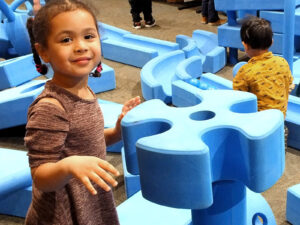
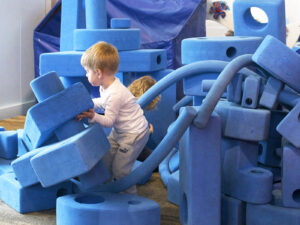
As children are playing with in each scenario, they are also exploring and developing concepts such as spatial awareness, balance, and cause and effect. The way a child plays with blocks will change and evolve as they go through several stages of block play. Each stage builds on the previous ones, and children will advance through them at their own rate as their skills develop.
Stage 1: Discovering/Exploring Blocks – At this stage, you may see children as young as infancy using their senses to explore blocks. They might bang them together to make a sound, throw them from their high chair to see what happens, try to take a bite out of it, and empty out a bin filled with blocks to watch and hear them tumble.
Stage 2: Stacking, Towers, and Rows – Children start to build simple towers and rows by placing them on top of and next to one another.
Stage 3: Bridges and Passageways – As they start to regularly engage in block play, they can start putting one block on top of a base of two to build a simple bridge. They may form tunnels and roads to move toy trains, cars, or balls.
Stage 4: Enclosures – Children develop an understanding of which ways to turn blocks. They may start with long roads then place blocks across to create sections and grids.
Stage 5: Patterns and Symmetry – Children begin to use more blocks and form more imaginative structures. At this stage, their developing fine motor skills allow them to build faster. You may notice them using patterns as they build and experimenting with balance, perhaps using round or triangular blocks.
Stage 6: Create and Recreate Familiar Structures – As children continue to advance and reinforce their block play development, they begin to use their blocks as a tool to represent real or imagined places, buildings, and objects. For example, they may use a wooden block set to create their own playground, complete with ramps for slides, bridge-like structures for monkey bars, and a few blocks stacked together to form stairs. Furthermore, they can use blocks to create new structures from their imagination such as a home for their favorite stuffed animal or a train depot with spaces for all of their toy vehicles.
According to the Illinois Early Learning Project, “block play encourages children’s physical, social, emotional, and cognitive growth.”1 Children build their hand strength, hand-eye coordination, and problem-solving skills as they plan and construct. Block play provides opportunities for them to learn to share, take turns, and work together to build. Since there’s no one correct way to use a set of blocks, children may feel a sense of accomplishment when they build a tower as tall as them—and triumph when they knock them all down! As children explore different types of blocks, you can help introduce vocabulary such as rectangle, tall, tower, bridge, above, below, and balance.
Blocks are a valuable learning tool for children, and several types of blocks can be found in our Build It! exhibit for children at all stages of development. Want to learn more about the science and benefits of block play? We offer Geometric Foundations of Block Play, a professional development workshop for educators and caregivers. For more information, please reach out to our Education Team at educationteam@kcmgc.org.
See you at the Museum!
Abby Ildefonso, Education Manager
References
1. Illinois Early Learning Project: Make Room for Blocks!
2. NAEYC: Rocking and Rolling. Building New Skills: Block Construction in Toddler Settings
3. Pathways: How to Play With Blocks at Every Stage
4. Tufts University: Developmental Stages of Block Play