At-Home Tools for Focused Exploration
April 2026
You may hear your young child talk excitedly about something fun they did during center or free choice time at school. They may remember their teacher reading them a story while they sat “criss-cross applesauce” on the classroom rug, and now they arrange their stuffed animals or dolls to sit in a similar way while they read from one of their board books. When preparing meals at home, your child may want a spatula of their own to help you prepare ingredients.
Children make sense of the world around them through play. They practice and reinforce what they’ve learned by imitating what they’ve observed and repeating what they’ve already done. This extends to the many observations of the world around them that they are making throughout the day. Everyday household tasks such as sorting and folding the laundry, using tools to tighten a valve under the sink or add batteries to a new toy, and loading groceries on to the conveyer belt at the store are all actions that a child might observe and want to try on their own.
In many early childhood classrooms, center or free-choice time is an opportunity for children to explore different content areas with focused, hands-on play. A math center may contain manipulatives such as fraction blocks, different types of counters, and measuring tools. An art center may contain crayons, markers, and interesting materials like cardboard that spark interest and creativity. Science centers can include materials that students can manipulate and investigate such as natural materials (pinecones, rocks, sticks, seed pods), tools for construction, or clipboards and magnifying glasses for observational drawings. Their dramatic play center may contain a play kitchen, costumes, dolls, and stuffed animals that they can use as props for role play.
Having readily available objects that are related to topics of interest provides opportunities for young children to explore in ways that are most effective for them: touching, moving, carrying, modeling, hearing, tasting, manipulating, and looking at closely. (Helm et al., 2023). A container and a few objects likely already around your home are all you need to create an exploration box for your child that they can easily access and engage with independently or with minimal guidance. Containers can be shoeboxes, small tote bins, and repurposed materials such as popcorn or cookie tins. Below are a few examples of exploration kits that can be made with common household items:
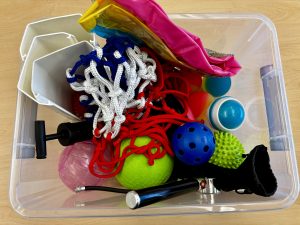
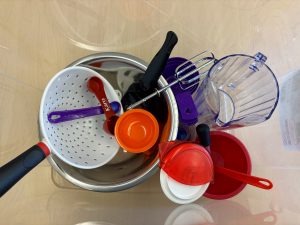
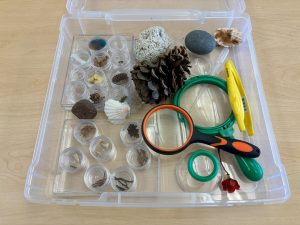
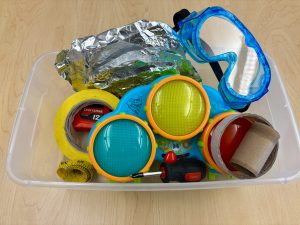
Cooking
- Plastic bowls
- Cooking or baking utensils (plastic or silicone spatulas, wooden spoon, measuring spoons and cups)
- Clean and empty condiment and spice containers
Clothing
- Clothespins
- Fabric scraps, rags, hand towels
- Outgrown clothing with buttons and zippers
Nature
- Pinecones
- Leaves
- Tip: Preserve leaves by soaking them in 1 part glycerin to 2 parts water or painting them with Modge Podge
- Sticks
- Dried, pressed flowers
- Rocks
- Magnifying glass
- Any treasures that your child may pick up while playing outside can be added to their nature exploration box!
Tinkering
- Miscellaneous recycled materials (cardboard tubes, boxes, plastic jugs and bottles,
- Tape
- Glue
- Broken toy parts (make sure batteries are removed and cut internal wires before taking apart)
- Small wooden pieces
Balls
- Assortment of balls – rubber bouncy balls, tennis balls, soccer ball, volleyball, whiffle balls
- Manual air pump
- Measuring tape
- Materials that can be used to make ramps
As your child is playing with these exploration boxes, ask them open-ended questions and prompts to encourage their curiosity and gain insight into what they are learning. Some examples are “Tell me about what you’re doing.”, “What else could we do with these materials?”, and “What do you notice?” to name a few. You may be surprised with what they have observed or are trying to understand through play.
Want to learn more about enhancing your science centers or at home explorations? We offer professional development topics for educators and caregivers such as The Value of Play and Sparking Curiosity through Scientific Play. For more information, reach out to our Education Team at educationteam@kcmgc.org.
See you at the Museum!
Abby Ildefonso
Manager of Education
References
Colker, L. J. (2013 January). 10 prop box ideas: Mini learning centers at home. NAEYC. https://www.naeyc.org/our-work/families/10-prop-box-ideas-mini-learning-centers-home
Early Math Project (2025 November). “Imagination Stations”. Early Math Project Newsletter. https://carolynpfister.substack.com/p/the-early-math-project-newsletter-dfd
Helm, J. H., Katz, L. G., & Wilson, R. (2023). Young investigators: The Project Approach in the early years (4th ed.). Teachers College Press.