The Benefits of Open-Ended Play
June 2026
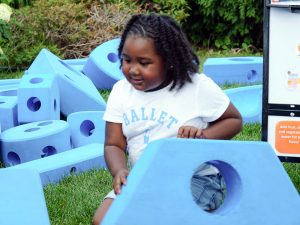
A group of children gather around a set of big foam blocks in the Museum’s Build It! exhibit. They are busy talking about what they want to build and which blocks to add next. As they continue to add blocks, a section topples over. The kids laugh, talk about how to rebuild it, and start building again.
This scenario is an example of open-ended play. Open-ended play provides opportunities for children to take charge of their learning and have fun doing it!
What is open-ended play?
Open-ended play is child-led. The child determines how to play, what materials to use, and how long the play will last. There are no pre-determined right or wrong answers. The child decides what success looks like. Is it building a block tower taller than they are or is it creating a rocket ship out of blocks and pretending to travel to the moon? It could be simply exploring the shapes and sizes of the blocks with no plan to “create” anything specific. All of these are examples of open-ended play.
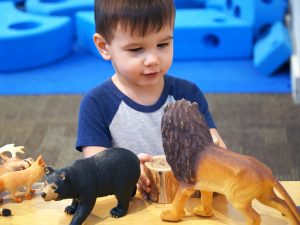
Open-ended play can take place just about anywhere. While no materials are required for open-ended play, some toys, like blocks, balls and ramps, small dolls or animal figures, and loose natural items can be used in multiple ways. Allowing children to take charge of their own play has many developmental benefits.
Creativity and Decision-Making
The less a toy does for a child, the more thinking, planning, and creating the child does. Children can build, design, create scenarios, and take their play in new directions each time they use the items. A child may decide to use small wooden blocks, for example, to build a tower, to pretend they are food to cook in a pretend pan, or to line up and count how many total blocks she has.
Language
Open-ended play, especially when done with others, promotes language development. When immersed in creative play, the participants need to communicate to keep the play going. Will the block structure be a castle or a rocket ship? Should the small sticks and stones be used to make a trail or a barrier to hop over? Discussing and negotiating during play gives children authentic reasons to hear and use new vocabulary words and communicate in more complex sentences.
Confidence
The more low-stakes opportunities a child has to learn by trial and error, the more resilient and confident the child becomes. For example, when a child’s block tower falls, she learns the play doesn’t end. She can try again and again until she reaches the goal she set.
When children jump into self-directed, open-ended play, they discover they can take charge of their experiences and learning. This gives children the confidence to try new things.
See you at the Museum!
Stephanie Bynum, Vice President of Programs